How Maxwell Discovered the Constant for Light
Note: This article serves as a live demonstration of how the framework renders complex mathematical equations and vector calculus symbols perfectly using GFM and KaTeX.
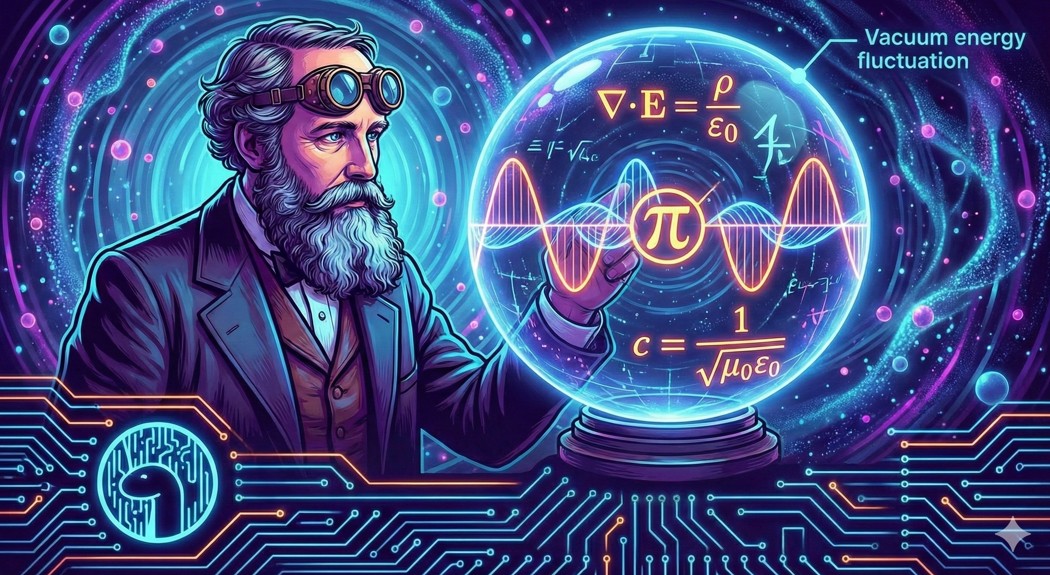
Imagine throwing a pebble into a calm pond and watching the ripples spread across the water. In the 1800s, James Clerk Maxwell discovered that light is just like those ripples—but instead of water, the "waves" are made of electricity and magnetism dancing through the void.
1. The Divine Dance: Electricity & Magnetism
Before Maxwell, people thought electricity (like a spark) and magnetism (like a compass needle) were two different things. Maxwell realized they are like two dancers in a perfect rhythm:
- A changing electric field creates a magnetic field.
- A changing magnetic field creates an electric field.
It's a "leap-frog" effect. One pushes the other, which pushes the first one back, over and over again. This self-sustaining cycle creates a wave that can travel through empty space forever.
2. The Great Realization
Maxwell wrote down four famous equations to describe this dance. While playing with these formulas, he discovered a "hidden" speed limit. It turns out this speed depends on two fundamental constants of nature:
- Magnetizability ($\mu_0$): How easily space allows a magnetic field to form.
- Electrizability ($\epsilon_0$): How easily space allows an electric field to form.
He then plugged these constants into his formula:
$$ v = \frac{1}{\sqrt{\mu_0 \epsilon_0}} $$
3. The "Aha!" Moment
At the time, Maxwell knew the speed of light from experiments (about 300,000 km/s).
When he calculated the speed of his "electromagnetic waves" using the numbers above, he got 310,740 km/s.
"The velocity of transverse undulations in our hypothetical medium... agrees so exactly with the velocity of light... that we can scarcely avoid the inference that light consists in the transverse undulations of the same medium which is the cause of electric and magnetic phenomena." — James Clerk Maxwell
4. Why This Matters Today
Maxwell's discovery didn't just explain light. By understanding that these waves can have different "vibrations," he predicted things he couldn't even see yet:
- Slow ripples: Radio waves (TV, WiFi, Cell phones).
- Medium ripples: Microwaves and Infrared.
- Fast ripples: Visible light (the colors we see).
- Super fast ripples: X-rays and Gamma rays.
Everything you use today—from your smartphone to your microwave—exists because Maxwell realized that light is just electricity and magnetism doing a high-speed dance across the universe.
The Path to the Discovery
To understand the math, we first need to understand the "secret language" of these symbols using a simple water analogy:
- The Dot ($\nabla \cdot$): The Spreader. Imagine an underwater hose. If you turn it on, water flows out from that point. If you stick a vacuum in, it flows in. This symbol asks: "Is energy being "born" or "dying" right here?"
- The Cross ($\nabla \times$): The Twister. Imagine stirring a cup of coffee. You create a circular motion. This symbol asks: "Is the energy "swirling" or "looping" around this point?"
- The Change ($\frac{\partial}{\partial t}$): The Pulse. Imagine a heart beating or a string vibrating. It stays in one spot, but its strength grows and shrinks. This symbol asks: "How fast is the field "vibrating" as time ticks by?"
To find the speed of light, Maxwell first had to unify everything we knew about electricity and magnetism into four pillars. In a vacuum, these equations describe how fields behave when there are no wires or magnets nearby:
- Gauss's Law: (No "Hoses") In empty space, electric fields just glide through. There are no "charges" here to act as a source or a sink.
$$
\nabla \cdot \mathbf{E} = 0
$$
The Logical Condition: This becomes zero only in a Vacuum. In the presence of matter, electric fields are created by charges (like electrons). But Maxwell was analyzing deep space, where the charge density ($\rho$) is exactly zero. Because there is no "hose" pumping new energy into the field, the spreading (divergence) must be zero.
- Gauss's Law for Magnetism: (No "Drains") Magnetic fields always form perfect loops. You will never find a "North pole" hose that doesn't have a "South pole" drain attached to it.
$$
\nabla \cdot \mathbf{B} = 0
$$
The Universal Condition: This is zero everywhere, not just in a vacuum. It represents the fact that "Magnetic Monopoles" do not exist. You can never have a North pole without a South pole. Since every line that leaves a point must eventually return to it, the net "spread" is always zero. It is impossible to create a magnetic "leak."
- Faraday's Law: (The Pulse-Twister) When a magnetic field pulses (vibrates), it automatically creates a twister (swirl) of electricity around it.
$$
\nabla \times \mathbf{E} = -\frac{\partial \mathbf{B}}{\partial t}
$$
The Clean Energy Condition: This law shows that you don't need a battery or a wire to create electricity. A moving magnet is enough. In the void of space, this ensures that any "magnetic pulse" traveling from a distant star automatically generates an electric companion.
- Ampère-Maxwell Law: (The Reverse Pulse-Twister) When an electric field pulses, it creates a twister of magnetism. This was Maxwell's stroke of genius.
$$
\nabla \times \mathbf{B} = \mu_0 \epsilon_0 \frac{\partial \mathbf{E}}{\partial t}
$$
Where did the $\mu_0 \epsilon_0$ come from?
- The Magnetic Constant ($\mu_0$): This was already part of Ampère's original law. It describes the "conversion rate" of how much magnetism you get from a moving electrical charge.
- The Electric Constant ($\epsilon_0$): Maxwell realized that a changing electric field ($\frac{\partial \mathbf{E}}{\partial t}$) acts like a "ghost current." Since this hidden current lives in space, it must be multiplied by the density/capacity of space itself ($\epsilon_0$).
- The "No-Wire" Condition: Normally, this equation starts with a term for physical Current ($J$). But in a Vacuum (empty space), there are no wires or moving electrons ($J = 0$). Maxwell proved that the product of these two constants ($\mu_0 \times \epsilon_0$) is the "universal coupling" that allows electricity to transform into magnetism even when there is no matter present.
Step 1: Searching for the Self-Sustaining Wave
Maxwell’s goal was to see if an electric field could propagate through empty space without any wires or charges. To do this, he performed a "stress test" on the electric field by taking the curl of the curl:
$$ \nabla \times (\nabla \times \mathbf{E}) = \nabla \times \left( -\frac{\partial \mathbf{B}}{\partial t} \right) $$
The Logical Sequence:
- Faraday's Discovery: We already know from Faraday that a changing magnetic field creates a "swirl" (curl) of electricity ($\nabla \times \mathbf{E}$).
- The "Swirl of a Swirl": By taking the curl again, Maxwell was essentially asking: "If this electric swirl is already rotating, how does that rotation spread to the space next to it?"
- The Substitution: He switched the order of operations on the right side—instead of looking at the "time change of a swirl," he looked at the "swirl of a time change." This allowed him to use his other equations to replace the magnetic field ($\mathbf{B}$) entirely.
- The Propagation: This mathematical move proved that an electric field isn't just a static spark; it "pushes" on the space around it, creating a chain reaction that moves outward like a ripple in a pond.
Step 2: Connecting the Dancers
Using his 4th equation, Maxwell realized he could replace the magnetic part $(\nabla \times \mathbf{B})$ with something that only involves the electric field.
To simplify the math, he used a standard vector identity: $$\nabla \times (\nabla \times \mathbf{E}) = \nabla(\nabla \cdot \mathbf{E}) - \nabla^2 \mathbf{E}$$
Because Gauss's Law states that $\nabla \cdot \mathbf{E} = 0$ in a vacuum, the first term vanishes, leaving:
$$ \underbrace{-\nabla^2 \mathbf{E}}_{\text{From Vector Identity}} = \underbrace{-\frac{\partial}{\partial t}}_{\text{From Faraday's Law}} \underbrace{\left( \mu_0 \epsilon_0 \frac{\partial \mathbf{E}}{\partial t} \right)}_{\text{Substitute for } \nabla \times \mathbf{B}} $$
After canceling the negative signs and combining the time derivatives, he arrived at a surprisingly clean result:
$$ \nabla^2 \mathbf{E} = \mu_0 \epsilon_0 \frac{\partial^2 \mathbf{E}}{\partial t^2} $$
This was the pivotal moment. Maxwell had successfully eliminated the magnetic field from the equation. He was left with a pure statement about how an electric field behaves in the void. But there was a problem: What did this mathematical "sentence" actually mean?
Step 3: Decoding the "Aha!" Moment
To understand his result, Maxwell had to look back 100 years to a "recipe" for vibration discovered by the French mathematician Jean le Rond d'Alembert.
In 1747, d'Alembert was studying violin strings. He discovered that for any vibration to travel through a medium as a wave, it must follow a very specific mathematical "template":
$$ \frac{\partial^2 f}{\partial x^2} = \frac{1}{v^2} \frac{\partial^2 f}{\partial t^2} $$
The "Translation" (Why this works):
If we translate these symbols into plain English, the logic becomes clear:
- $\frac{\partial^2 f}{\partial x^2}$ (The Curvature): This measures how "bent" the thing ($f$) is in space.
- $\frac{\partial^2 f}{\partial t^2}$ (The Acceleration): This measures how fast the thing "snaps back" in time.
- The $v$ (The Speed): This is the speed at which the disturbance travels.
The Cause and Effect: d'Alembert's secret was realizing that the sharper the bend in space, the faster it accelerates back to normal. The ratio between these two is the square of the speed ($v^2$).
Matching the Patterns:
Maxwell placed his result side-by-side with d'Alembert's template and the similarity was undeniable:
- Maxwell's Result: $\nabla^2 \mathbf{E} = (\mu_0 \epsilon_0) \frac{\partial^2 \mathbf{E}}{\partial t^2}$
- d'Alembert's Template: $\nabla^2 f = (\frac{1}{v^2}) \frac{\partial^2 f}{\partial t^2}$
Wait—they were identical! The symbol $\nabla^2$ was just the 3D version of d'Alembert's 1D curvature. By plucking the "string" of the electric field, Maxwell had inadvertently triggered the same mathematical wave behavior discovered a century earlier.
Step 4: Finding the Speed of Light
If the two equations were the same, then the parts that occupy the same "slots" must also be the same. This led to the final, world-changing deduction:
- The Slot: In d'Alembert's template, the slot for the wave's speed was $\frac{1}{v^2}$.
- The Filler: In Maxwell's result, that exact same slot was filled by $\mu_0 \epsilon_0$.
- The Conclusion: Therefore, the speed of an electromagnetic wave must be $v^2 = \frac{1}{\mu_0 \epsilon_0}$.
By isolating $v$, he got the famous formula: $$v = \frac{1}{\sqrt{\mu_0 \epsilon_0}}$$
The Shocking Result:
When he plugged in the values for $\mu_0$ and $\epsilon_0$ (measured in small labs using simple batteries), the result was 310,740,000 meters per second.
Maxwell knew from astronomical observations that light traveled at roughly 300,000,000 meters per second. The similarity was too perfect to be a coincidence. He had just discovered that light is not its own "substance"—it is the result of electricity and magnetism leap-frogging through the void at the maximum speed the fabric of space allowed.
The Conclusion: Light is an electromagnetic wave. This single calculation unified optics, electricity, and magnetism into one single field of science.
The Final Revelation
If the vacuum were truly "nothing," it wouldn't have properties like $\mu_0$ or $\epsilon_0$. The fact that light has a fixed speed limit proves that even "empty" space has a texture—an invisible fabric that dictates how energy must move.
This leaves us with one haunting question: If the void can have properties, is it really a void at all?