CMS Architecture: Why Databases Are Starting to Feel Like a Legacy Burden?
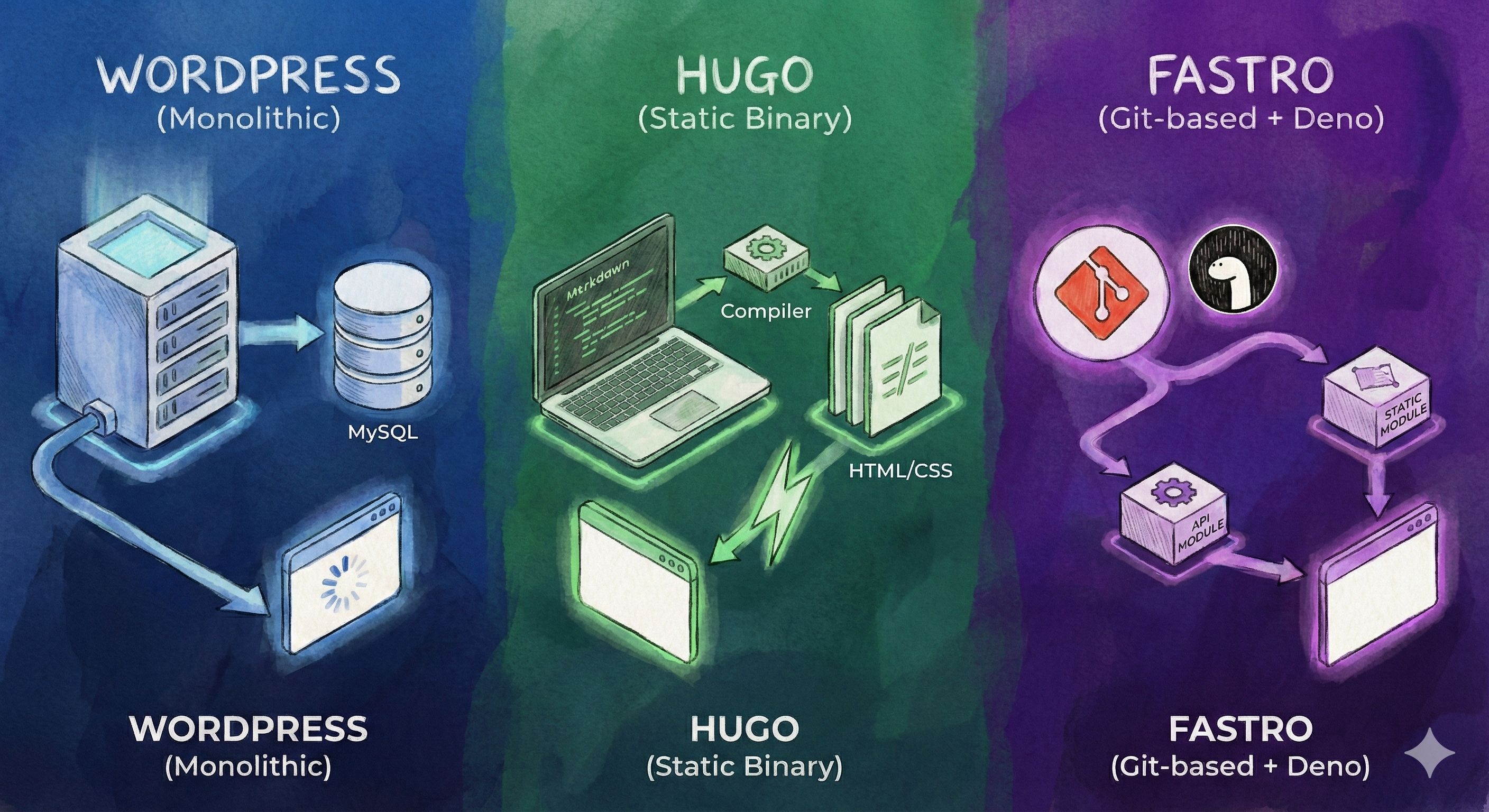
For developers who have spent years working with PHP and MySQL in the WordPress ecosystem, or perhaps tried migrating to Hugo for speed, we know that every choice brings its own "technical debt." However, in 2026, the landscape has shifted toward a purer form of efficiency.
Here is an architectural breakdown between the monolithic database approach and static binary generation, and why Git-based CMS has become the most sensible meeting point for modern developers.
1. WordPress: Monolithic and the Performance Dilemma
We all know how it works: PHP processes the request, queries the MySQL database, and renders HTML on-the-fly.
- Runtime & Overhead: WordPress is highly dependent on server-side processing efficiency. The problem is, the more plugins you add, the greater the overhead on memory and CPU.
- Centralized Security: The database is a Single Point of Failure. Without strict hardening configurations, SQL Injection and plugin vulnerabilities remain a real threat.
- Modularity via Plugins: The WordPress ecosystem is powered by thousands of plugins (free & paid) that allow adding features without touching the core code, but they risk conflicts between plugins.
- Caching as a Lifesaver: In WordPress, caching isn't an optional feature; it's a necessity to keep the site from collapsing under high traffic.
- Stack Summary:
- Language: PHP (Server-side) & MySQL (Database)
- Cost Efficiency: Requires a budget for Hosting (~$5-30/mo), Domain, and potential costs for premium Plugins/Themes.
- Hosting: Shared Hosting (Bluehost, Niagahoster), VPS, or Managed WordPress (WP Engine).
2. Hugo: Binary Speed, but Rigid Workflow
Hugo removes the database entirely. Written in Go, it compiles Markdown into static files in milliseconds.
- No Runtime on Server: Since the output is pure HTML/CSS, there is no computation process when a user visits. This is the peak of latency efficiency.
- Fiction vs. Reality of Deployment: Although its build time is extremely fast, the workflow can often be frustrating. You need a mature CI/CD pipeline just to fix a single typo.
- Themes & Hugo Modules: Hugo uses a powerful theme system and "Hugo Modules" based on Go Modules to manage components, assets, and configurations modularly.
- Dynamic Content Limitations: Want to add comment features or search? You are forced to rely on third-party services that often add client-side script weight.
- Stack Summary:
- Language: Go (Golang) - Compiled for speed.
- Cost Efficiency: Highly Economical. Free static hosting (Netlify/Vercel). Costs are only for the Domain (~$15/yr).
- Hosting: Static Hosting like GitHub Pages, Netlify, Vercel, or Cloudflare Pages.
3. Git-Based CMS: Making Git the "Single Source of Truth"
This is where a modern ecosystem like Fastro comes in to offer a more elegant solution. As a framework running on the Deno runtime, Fastro combines high performance and security without the complexity of traditional databases.
- Version Transparency: Instead of storing content in "dark" database tables, we use Git. Every change has a commit hash, providing industry-standard version control for your content.
- Modules & Middleware: Fastro adopts a clean autoloading modules and middleware pipeline system. Adding a feature means adding a new file in the
modules/directory without breaking existing application logic. - Flexible Architecture: The main advantage is module flexibility. You can easily add additional modules, whether they are static for maximum performance or dynamic (API) for interactivity.
- Scientific Security: This clean architectural approach allows developers to manage code with high precision, similar to how Maxwell's equations simplify electromagnetic phenomena into an efficient harmony.
- Stack Summary:
- Language: TypeScript/JavaScript (Deno Runtime).
- Cost Efficiency: Highly Efficient. Free Edge hosting (Deno Deploy). Costs are only for the Domain (~$15/yr).
- Hosting: Serverless Edge (Deno Deploy) with minimal latency, or standard VPS via Docker.
Feature Comparison
| Feature | WordPress | Hugo | Fastro (Deno) |
|---|---|---|---|
| Main Language | PHP | Go (Golang) | TypeScript/JS |
| Architecture | Monolithic (SSR) | Static (SSG) | Git-based / Edge |
| Modularity | Plugins (Huge ecosystem) | Themes & Modules | Modules & Middleware |
| Data Storage | MySQL Database | Markdown Files | Git + Deno KV |
| Est. Monthly Cost | $\$10$ - $\$50+$ (Hosting+Plugin) | $\$0$ (Free Hosting) | $\$0$ (Free Edge Hosting) |
| Performance | Medium (Needs Cache) | Extreme (Static) | High (Edge Compute) |
| Security | Moderate (Plugin Risk) | High (No Server) | High (Sandboxed) |
| Workflow | Dashboard UI | CLI / Git | Git-Centric |
| Ideal Use Case | Business/News Site | Simple Static Site | High-Perf Web App |
Conclusion: From Monolithic to Clean Architecture
Choosing a CMS today is no longer about "which is most popular," but which has the cleanest architecture. If WordPress is a steam engine requiring constant maintenance, and Hugo is a rigid racing car, then a Git-based CMS on Fastro is the nimble vehicle of the future.
By leveraging Deno, you get a system that is secure by default and ready to scale at any time.